
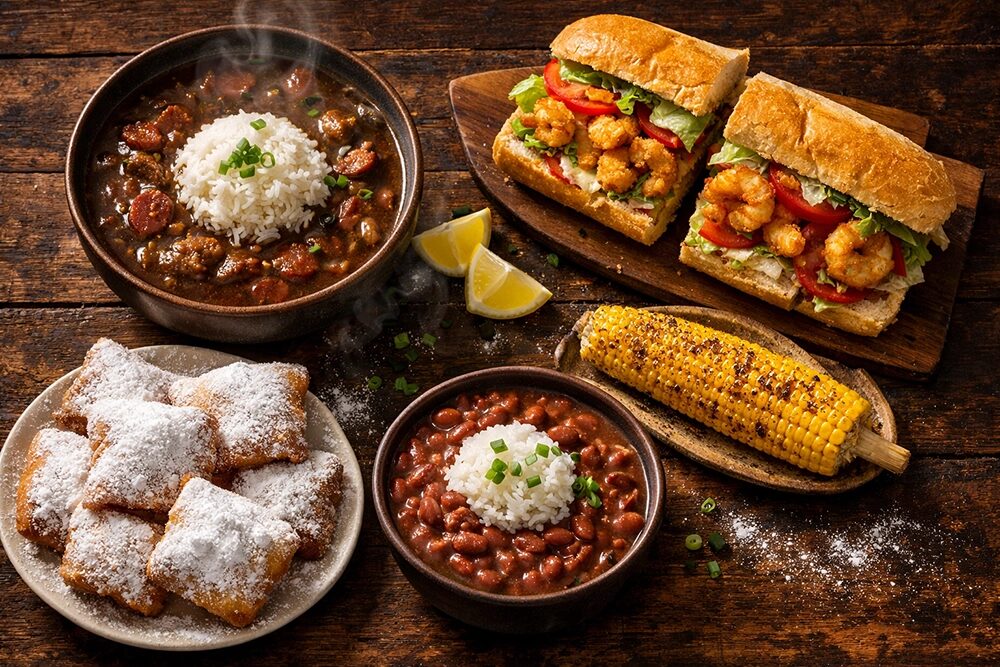
Close your eyes for a moment and picture it. A steaming bowl of dark, rich gumbo set down in front of you, the smell of Creole spices rising with the heat. The crunch of a po boy loaded with fried shrimp, dressed just the way it should be. A plate of beignets arriving in a cloud of powdered sugar so generous it drifts onto your shirt before you can even reach for one. This is New Orleans food — and there is nothing else quite like it anywhere in the world.
New Orleans has one of the most distinctive and celebrated culinary traditions in North America. It didn’t happen by accident. Centuries of cultural convergence, geographic fortune, and pure human creativity all came together in this one city on the Mississippi to produce a food culture that is entirely its own. Understanding where these dishes come from — and what makes them so enduring — adds a whole new layer to the experience of eating them.
This guide walks through the most iconic New Orleans food traditions: the history behind them, what makes each one special, and why they continue to define the city’s identity. And because these traditions are very much alive and evolving, we’ll note where vegan and gluten-free versions of these classics are making the old dishes new again.
Why New Orleans Food Is Unlike Anything Else
Before diving into the dishes themselves, it helps to understand the cultural soil they grew out of. New Orleans is not like other American cities, and its food reflects that difference in every bite.
The city’s cuisine is the product of an extraordinary collision of cultures. French colonists arrived in the early 1700s and established the foundational cooking techniques — the roux, the court-bouillon, the love of rich sauces. The Spanish, who controlled Louisiana for nearly four decades in the 18th century, layered in their own flavors and methods. West African enslaved people, who did much of the actual cooking in colonial New Orleans kitchens, contributed ingredients, techniques, and flavor sensibilities that are inseparable from what Creole food became. The Choctaw and other Native peoples of Louisiana contributed ingredients like filé powder and a deep knowledge of the local land. Sicilian and other European immigrants added their own threads to the weave in the 19th century. Haitian and Caribbean influences flowed in continuously across the Gulf.
The result is a cuisine that no single group can fully claim — and that is precisely what makes it so rich.
Two terms come up constantly when talking about New Orleans food, and they are worth distinguishing. Creole cooking is the food of the city itself — New Orleans proper — historically rooted in the households of the Creole upper class and shaped by that dense mix of French, Spanish, African, and Caribbean influences. It tends to use tomatoes more liberally and has a reputation for refinement. Cajun cooking is the food of rural Louisiana — the bayous and prairies to the west — brought by French Acadian settlers who were expelled from Canada in the 1700s. It is heartier, smokier, and typically cooked without tomatoes. In practice, the two traditions have influenced each other so thoroughly over the centuries that the lines blur constantly, and most New Orleanians are comfortable with the overlap.
What both share is an unwillingness to be boring. New Orleans food is bold, layered, deeply seasoned, and built for community.
Gumbo — The Soul of Louisiana
If any single dish represents New Orleans, it is gumbo. It appears at holiday tables, backyard gatherings, neighborhood diners, and fine restaurants alike. It has been feeding the city through good times and hard ones for over two centuries. Ask a New Orleanian about their family’s gumbo recipe and you’ll likely get a passionate, detailed answer — possibly with some strong opinions about how other people do it wrong.
What Is Gumbo?
At its core, gumbo is a thick, deeply flavored stew served over white rice. The base is built on a dark roux — flour and fat cooked together over low heat, stirred constantly, for anywhere from thirty minutes to an hour, until it turns the color of dark chocolate or brick red. This roux is the foundation of everything. It gives gumbo its distinctive deep flavor, its color, and its body. Rush it and you’ll ruin the whole pot.
From there, gumbo is built with what Louisiana has always had in abundance: the “holy trinity” of Creole cooking (onion, celery, and green bell pepper), Creole seasonings, and whatever proteins the cook has on hand — chicken, sausage, shrimp, crab, oysters, or some combination. It is simmered long and slow, served in a bowl with a scoop of rice in the center, and eaten as a complete meal.
The History
Gumbo is a dish that tells the whole story of New Orleans in miniature. The word itself comes from ki ngombo, the Bantu word for okra — the ingredient that West African cooks brought to Louisiana and used as a thickening agent for stews. The Choctaw people contributed filé powder, made from ground dried sassafras leaves, which serves the same thickening purpose and adds its own subtle, earthy flavor. French settlers contributed the roux technique, adapted from their own classical cooking. Every major cultural group that shaped New Orleans left a fingerprint on gumbo.
The dish appears in historical records as far back as the early 1800s, and it has been in continuous, beloved use ever since. After Hurricane Katrina, when displaced New Orleanians were scattered across the country, gumbo became a symbol of home and resilience in a way that surprised even those who had always taken it for granted.
Variations Worth Knowing
Gumbo is not a single recipe. It is a family of dishes held together by technique and spirit. Chicken and andouille sausage gumbo is the most common version — smoky, rich, and hearty. Seafood gumbo brings in Gulf shrimp, blue crab, and oysters for something lighter and brinier. Some cooks thicken with okra, some with filé, and some with both (though purists will argue that using both at once is a choice with consequences). Creole gumbo often includes tomatoes; Cajun gumbo typically does not.
Vegan gumbo has also emerged as a genuinely excellent alternative, proving that the soul of the dish lives in the roux, the seasoning, and the technique rather than in any particular protein. At Meals From the Heart Cafe, both a traditional and a vegan okra gumbo are on the menu — and both are gluten-free, built on that same slow-cooked foundation.
What Separates a Great Gumbo from a Mediocre One
It almost always comes down to the roux. A properly dark roux takes patience that many cooks underestimate. Pull it off the heat too soon and the gumbo will be pale and flat. Burn it — even slightly — and the whole pot tastes bitter. The window between perfectly done and ruined is narrow, and getting it right consistently is a genuine skill. When you eat a great gumbo in New Orleans, you are tasting someone’s hard-won expertise.
Po Boys — The Sandwich That Built a City
New Orleans has no shortage of great things to eat, but the po boy holds a special place in the city’s heart. It is everyday food elevated by the quality of its ingredients and the specificity of its bread — a combination that has made it iconic far beyond Louisiana.
What Is a Po Boy?
A po boy is a sandwich served on a very particular kind of French bread: a long, thin loaf with a shatteringly crispy crust and an interior so light and airy it almost dissolves. This bread is not something you can replicate easily outside of Louisiana. Local bakeries — most famously Leidenheimer’s, which has been supplying New Orleans restaurants since 1896 — produce a loaf that is shaped by the city’s humidity and the specific character of the local water. Take the bread out of New Orleans and the sandwich changes. It cannot be helped.
The filling can be almost anything. Fried shrimp, fried oysters, roast beef with gravy, catfish, soft-shell crab, and crab cakes are all classics. The sandwich comes in varying lengths — a “half” is typically six inches, a “whole” is a foot — and is usually ordered either dressed or undressed.
Dressed or Undressed?
This is a cultural touchstone that visitors should understand before they order. “Dressed” means the sandwich comes with lettuce, tomato, pickles, and mayonnaise. “Undressed” means none of that — just bread and filling. Locals have strong feelings about how their po boys should be dressed, and the question is asked at every counter. It is not a small thing.
The Origin Story
The po boy has one of the most specific and charming origin stories in American food history. In 1929, during a bitter strike by New Orleans streetcar workers, two brothers named Bennie and Clovis Martin — themselves former streetcar conductors — began serving free sandwiches to the striking workers from their restaurant on St. Claude Avenue. Every time a striker came in, one of the brothers would reportedly call out, “Here comes another poor boy.” The sandwich they served, piled generously onto French bread to make the most of limited resources, took on that name and never let it go.
The story captures something important about New Orleans food culture: its deep connection to community, labor, and the democratizing idea that good food belongs to everyone.
What to Order
For first-timers, a fried shrimp po boy dressed is hard to beat — the crunch of the shrimp against the soft interior of the bread, with the cool crispness of the lettuce and tomato, is the full experience in one bite. Roast beef po boys, where the slow-cooked meat and its dark gravy soak into the bread, are a beloved mess worth making. For those avoiding meat, a vegan crab cake po boy — like the one served at Meals From the Heart Cafe — delivers the same satisfying structure with a plant-based twist that holds its own against any traditional version.
Beignets — The Powdered Sugar Experience
There are foods you eat, and there are foods you experience. Beignets fall firmly in the second category. The food itself is simple. The ritual around it is something else entirely.
What Is a Beignet?
A beignet (pronounced ben-YAY) is a square of fried dough — no hole, no fancy shape — served hot and buried under a quantity of powdered sugar that can only be described as generous to the point of absurdity. The outside is lightly crispy. The inside is soft, airy, and pillowy in a way that is difficult to achieve and immediately recognizable when someone gets it right. The word is French for “fritter” or “fried pastry,” and the concept has roots across many cultures, but New Orleans made it its own.
The History
Beignets were brought to Louisiana by French Acadian settlers — the Cajuns — in the 18th century, part of the wave of French-speaking immigrants who fled Canada after the British expelled them from Acadia (modern-day Nova Scotia). They carried their food traditions with them into the bayous and eventually into the city, and the beignet took root.
Café Du Monde, the legendary open-air coffee stand on Decatur Street at the edge of the French Market, has been serving beignets since 1862 and is largely responsible for making them known around the world. In 1986, the Louisiana state legislature made it official: the beignet is the state doughnut of Louisiana.
The Experience
The ritual matters as much as the food. You sit outside — often at a small table with a metal chair, often with café au lait in hand, often with the Mississippi just visible beyond the levee and the distant sound of a street musician carrying across the square. The beignets arrive hot. The powdered sugar is immediate and enormous. Every New Orleanian will tell you to wear something dark, and every New Orleanian is right. You will be covered in sugar. This is part of it.
Vegan and Gluten-Free Beignets
For a long time, anyone who was vegan, dairy-free, or gluten-free had to sit out the beignet experience — watching others eat while settling for a coffee. That has changed. At Meals From the Heart Cafe, vegan beignets made without eggs or dairy deliver the same hot, fluffy, powdered-sugar-buried experience that the city has been serving for over a century. A gluten-free version is available as well. The flavor and texture hold up. No one has to miss out anymore.
Jambalaya — One Pot, One Party
If gumbo is the soul of New Orleans cooking, jambalaya might be its heartbeat. It is the dish of celebrations and gatherings, of big pots set on outdoor burners at festivals and family reunions, of the kind of cooking that feeds a crowd without fuss or pretense.
What Is Jambalaya?
Jambalaya is a one-pot rice dish in which everything — meat, vegetables, aromatics, and rice — cooks together until the rice has absorbed all of the surrounding flavor. The result is a complete, deeply satisfying meal that carries the character of whatever went into it. It is hearty, economical, and endlessly adaptable.
Creole vs. Cajun Jambalaya
Here again, the Creole-Cajun distinction matters. Creole jambalaya, sometimes called “red jambalaya,” includes tomatoes, which give it a reddish color and a bright acidity that balances the richness of the meat. Cajun jambalaya — “brown jambalaya” — omits the tomatoes entirely, and its color comes instead from the browning of the meat against the bottom of the pot, which creates a deeper, smokier base. Both are considered authentic. Both are delicious. Arguing about which is better is a beloved Louisiana pastime.
The History
Jambalaya’s roots trace back to the Spanish presence in Louisiana. The dish is closely related to paella, which Spanish settlers brought with them in the 18th century, and the name itself may derive from the Spanish jamón (ham) or from a Provençal word, jambalaia, meaning a mishmash. As Spanish cooking met West African, French, and Native American influences in Louisiana, the dish evolved into something distinctly its own — paella’s spiritual cousin rather than its replica.
Today jambalaya is one of the dishes most likely to appear at festivals, community events, and neighborhood cookouts across Louisiana. Pots that serve hundreds of people at once are not unusual. It is food that scales with the size of the party.
Red Beans and Rice — The Monday Tradition
Of all the New Orleans food traditions, the one that is most woven into the rhythm of daily life may be red beans and rice on Monday. It is not a special occasion dish. It is a weekday institution.
What It Is
Red beans and rice is a slow-cooked dish of red kidney beans simmered with andouille or smoked sausage, onion, celery, bell pepper, and Creole seasonings until the beans are tender and the whole thing has thickened into a rich, hearty stew. It is served over white rice and eaten as a complete meal. Simple, deeply satisfying, and — like most New Orleans food — built on patience.
Why Monday?
The tradition of eating red beans on Monday dates back to the era before washing machines. Monday was laundry day in New Orleans households, an all-day physical labor that left little time for cooking. Red beans were the perfect solution: they could be put on the stove in the morning with minimal preparation and left to simmer unattended all day, ready to eat by dinner without requiring anyone to stand over a pot. The custom persisted long after washing machines made laundry day a much less exhausting affair. Some things stick because they are too good to give up.
The tradition is so embedded in the city’s culture that Louis Armstrong — one of New Orleans’ most beloved sons — reportedly signed many of his personal letters “Red beans and ricely yours.” It is a small detail that says a great deal about how deeply food is tied to identity here.
Vegan Versions
Red beans and rice adapts beautifully to plant-based cooking. The sausage can be replaced with smoked mushrooms, plant-based andouille, or simply omitted in favor of more deeply seasoned beans, and the depth of flavor barely suffers. The beans and the seasoning do the heavy lifting regardless.
Crawfish Boils — Louisiana’s Favorite Gathering
If red beans and rice is the Monday tradition, the crawfish boil is the weekend celebration. It is less a dish than an event — a reason to gather, to stand around a table covered in newspaper, and to eat with your hands for two hours while the conversation flows as freely as the seasoning.
What Is a Crawfish Boil?
A crawfish boil is exactly what it sounds like: live crawfish cooked in a massive pot of heavily seasoned boiling water, then dumped out onto a table and eaten communally. The crawfish are joined in the pot by corn on the cob, red potatoes, smoked sausage, mushrooms, onions, and sometimes artichokes or whole heads of garlic — all of it absorbing the same spiced, salty, deeply flavored water. Everything comes out of the pot tasting like Louisiana.
Eating crawfish is a tactile, hands-on experience. You twist the tail from the head, peel back the shell, and pull out the small piece of meat inside. Some people suck the head — which sounds alarming if you’ve never heard it and is considered entirely normal if you have — to get at the seasoned fat inside. There is no graceful way to eat crawfish. That is considered part of its charm.
The History
Crawfish have been harvested in Louisiana for thousands of years. Native American communities relied on them as a food source long before European settlers arrived. The French settlers who came to Louisiana recognized a good thing and incorporated crawfish into their cooking in the early colonial period. Over time, as Cajun culture developed in the rural parishes west and south of New Orleans, the crawfish boil became a cornerstone of community life — a tradition tied to the annual crawfish season rather than any particular holiday or occasion.
Crawfish season in Louisiana typically runs from late January through June, with March, April, and May representing the peak. During those months, crawfish boils appear in backyards, at festival grounds, outside of gas stations, and in parking lots across the state. The availability is part of the culture — when crawfish are running, you eat crawfish.
The Ritual
What distinguishes a crawfish boil from most other meals is how thoroughly it is organized around togetherness. There is no plating, no individual portions, no waiting for your turn. The pot is dumped onto a communal surface and everyone eats from the same pile. Conversation, cold drinks, and the slow work of peeling are the structure of the afternoon. It is one of the most genuinely communal food experiences in American culture, and it is very difficult to rush.
The seasoning is another point of local pride. Every cook has a preferred blend — Zatarain’s and Louisiana Fish Fry are the most common commercial bases — along with their own additions: extra cayenne, lemon halves, bay leaves, whole peppercorns, and sometimes a stick of butter added at the end so the crawfish glisten. The heat level varies from mild to genuinely punishing depending on whose boil you’re at, and asking beforehand is always a reasonable idea.
More Dishes Worth Knowing
New Orleans food culture runs wider than any single list can capture, but a few more dishes deserve mention for anyone trying to understand the full picture.
Étouffée is a rich, buttery sauce — the word means “smothered” in French — typically made with crawfish or shrimp and served over rice. It is deeply Cajun in character, built around the holy trinity and seasoned with a restraint that lets the seafood speak. A properly made étouffée is one of the most purely satisfying things you can eat in Louisiana.
The muffuletta is New Orleans’ answer to the deli sandwich and its only real rival to the po boy in the city’s sandwich pantheon. It was created in 1906 at Central Grocery on Decatur Street by a Sicilian immigrant named Salvatore Lupo. The sandwich is built on a large, round sesame-seeded loaf and filled with Italian cured meats, provolone, and — crucially — an olive salad that makes the whole thing distinctive. The bread soaks up the olive oil from the salad and becomes something it was not when it started. It is best ordered and eaten half an hour later.
Pralines are the sweet signature of New Orleans. These pecan-studded caramel candies, sold at candy shops and market stalls all over the French Quarter and French Market, have a buttery richness that is immediately addictive. The name traces back to a French diplomat, César du Plessis-Praslin, whose chef is credited with the original almond version. Louisiana swapped in pecans — native to the region and far more available — and the praline became its own thing entirely.
King cake is the edible symbol of Mardi Gras: a ring-shaped pastry glazed in the purple, gold, and green of the Mardi Gras flag, often filled with cream cheese or cinnamon, and always containing a small plastic baby figurine hidden somewhere inside. Whoever gets the slice with the baby is supposed to provide the next king cake, continuing the cycle through the Carnival season. Vegan king cake options have become increasingly available in recent years, opening the tradition to more people.
Finally, no account of New Orleans food culture is complete without mentioning café au lait and chicory coffee. New Orleans has long brewed its coffee with chicory root — a practice that began during the Civil War when coffee was scarce and has simply never stopped, because chicory gives the coffee a distinctive, slightly earthy depth that locals came to love. A café au lait — half chicory coffee, half steamed milk — is the standard morning drink, the natural companion to beignets, and one of the small pleasures that make the city feel like itself. Dairy-free milk alternatives are now widely available throughout the city.
Experiencing New Orleans Food Traditions Today
What is remarkable about New Orleans food is not just its history but its vitality. These are not museum pieces. Gumbo is still being made from scratch in homes and restaurants across the city every day. Po boys are still being dressed at lunch counters the same way they were a century ago. The traditions are alive because the community keeps them alive — passing down recipes, arguing about methods, adapting to new ingredients and new circumstances while holding onto what matters.
That adaptability is itself part of the tradition. New Orleans cuisine was always the result of different cultures taking what they had and making it better together. The rise of excellent vegan and gluten-free versions of iconic New Orleans dishes is a continuation of that same spirit, not a departure from it. A vegan gumbo that is built on a proper dark roux, seasoned with the same depth of care, and served with the same pride as any traditional bowl is as New Orleans as it gets.
At Meals From the Heart Cafe in the French Market, you can find both sides of that story on the same menu. Traditional gumbo, vegan gumbo. Fried crab cakes, vegan crab cakes. Beignets made the classic way, and beignets made without eggs or dairy. It is a kitchen that takes the city’s food seriously enough to make sure everyone at the table can participate.
The Food Is the City
People travel to New Orleans for the music, the architecture, the festivals, the particular quality of light in the French Quarter at dusk. But ask most of them what they remember most vividly, and a large number will answer with food. The gumbo they had on a Tuesday. The po boy they ate standing up, sauce dripping down their arm. The beignets that covered their shirt and that they somehow didn’t mind at all.
That is what a great food tradition does. It does not just feed people. It makes them feel something — a sense of place, of warmth, of being somewhere that has figured out something important about how to live. New Orleans figured it out a long time ago, and it has been generous enough to share ever since.
If you are planning a visit to New Orleans, the French Market is one of the best places to begin. Stop in and try something from the menu at Meals From the Heart. Whether you are vegan, gluten-free, or just hungry for something that tastes like the real New Orleans, there is a bowl or a plate here with your name on it.
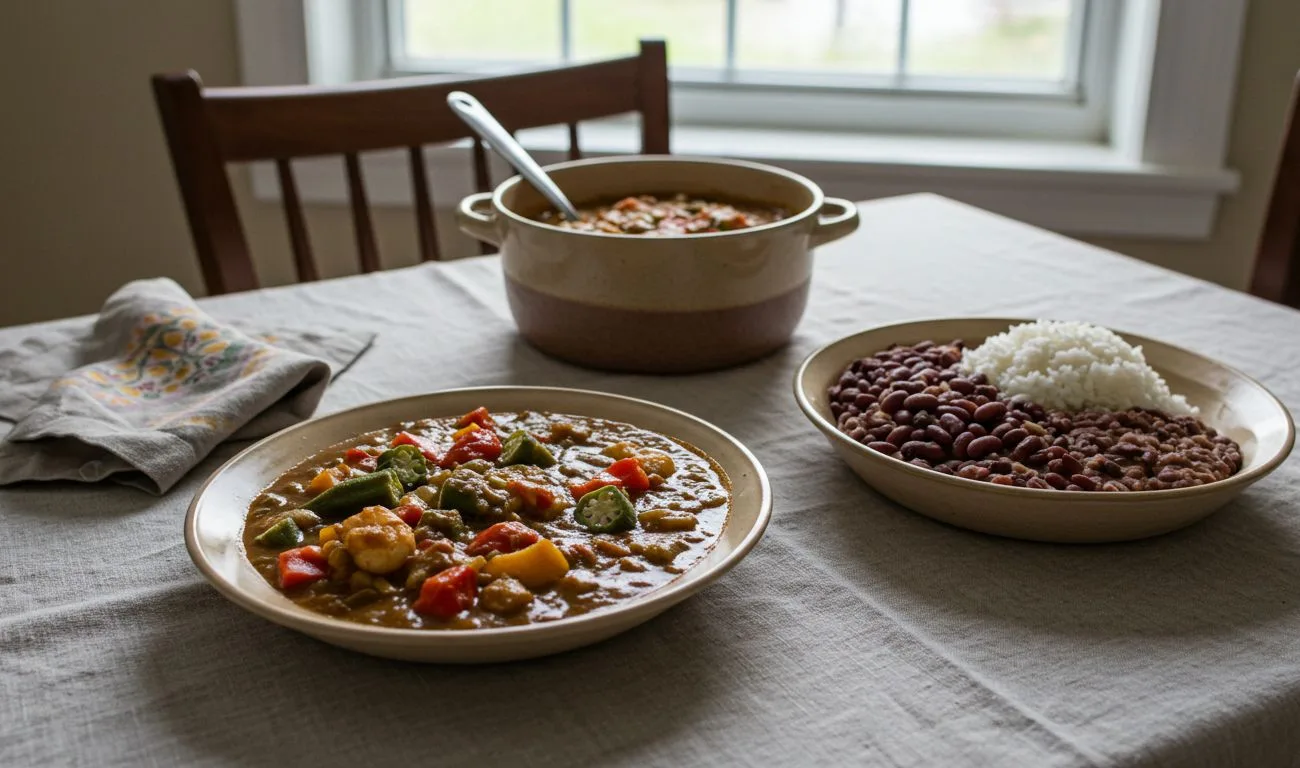
New Orleans Plant-Based Comfort Food: A Culinary Revolution
In the vibrant, music-filled streets of New Orleans, food is far more than just sustenance—it’s
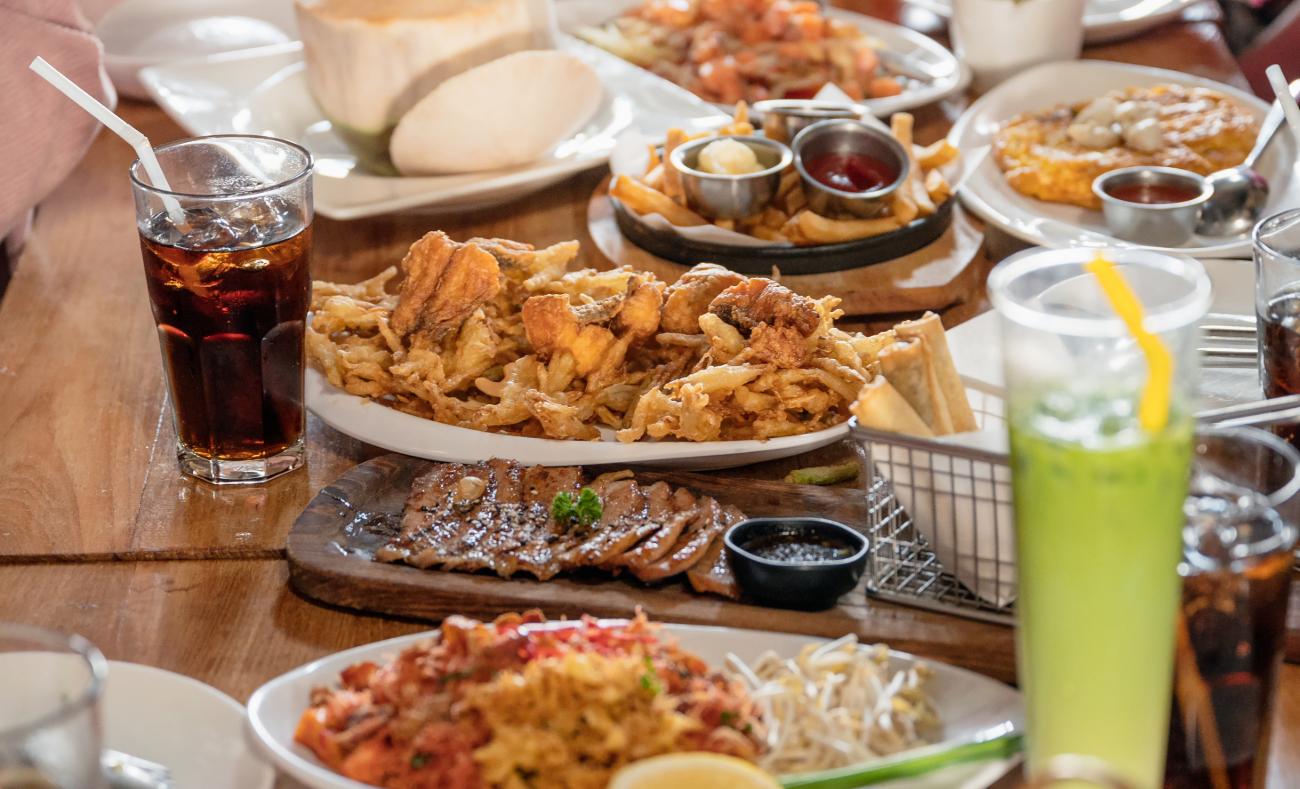
A Comprehensive Guide to Eating Healthy in New Orleans
Your guide to eating healthy in New Orleans. Find Eat Fit approved restaurants, vegan options, glute